Week 2- Reconnect

This week I scanned myself in a couple of different poses. I tried to  channel Anna Mendieta and classic Yemaya imagery with three different poses. The one with my hands on my face seemed to be the most honest to me. I want try out some more poses and I feel that I need to scan myself naked. I will try that out next week.statueexample2statueexample1

I researched and found some examples of what I want my final project to look like.  The material on the right is carved alabaster and slip-castnparian pocelian. They are about 10 inches tall. I researched some 3D printers and Parson and NYU have one that produce ceramic prints. The problem is it takes two weeks to print so this means that by the next two weeks I need to have my model done. I will then hand paint the sculpture as to give a botanica aesthetic.

Posted in general | Comments Off on Week 2- Reconnect

WW11: Week 2 gwen Process notes

i took a trip down to my old friends at canal plastics and plastic land to look at the wall of vinyl and mylar options. I was surprised to find out that 48 “ is widest for mylar on roll. So i walked away empty handed and ordered “size large” emergency blankets 62” x 53” on amazon.com.

tested time warp options in aftereffects recommended by Sharon.
not sure if i exported it right.

one question that came up last week was the idea of mirroring the iceberg to see the invisible ice block hidden below the surface of the water. mirrors, mylar, plastic, plexiglass, tests. This has me thinking about how I would best want this shown. If I could choose, possibly a high polished cement floor that would reflect the projection would be best so there is the option to see the mirrors image in the floor from a distance. My only concern with using a reflective material is the possible locking down of the imagery- would it no longer be seen as a mountain or a landforms an only as a iceberg or wave if it was mirrored?
I tested:
-plexiglass (video)
-full length mirror /with frame. but needs to be frameless. ( video)
-thick mylar mounted on cardboard ( video)
-acetate (video) and acetate with a fan

https://photos.app.goo.gl/zyLRSdr1vNBcYLeg1

the acetate was surprise when the projector light went through it as it caused more aurora borealis effect. I may need to replace the plastic sheeting with acetate when i record with the mylar.
IMG_2457

and now i wonder if there should be acetate and lights in an installation in the gallery?

a curved free standing paper or fabric structure to project onto? tested projected onto fabric , trying to make it curved. (video)

Friday afternoon was a very windy. it was 20 degrees and blowing 25mph. the insulation plastic on one of our windows was bellowing out and making crinkly noises. ( video)

check out the cool new prescription caps with timers. what if there was a table of them and the audience could open them all, they have different times on them. But what to put inside? i feel it could be useful for the idea of time running out, time machine, ticking “time bomb”. ideas for what to put inside?maybe it could work for someone- put some of Tamara’s contaminated soil in there!?
IMG_2405

Posted in general | Comments Off on WW11: Week 2 gwen Process notes

What Remains

Some thoughts about last Sunday’s meeting:

This reminded me of Sharon’s idea but an interesting photo series for anyone to see:

https://fabricemonteiro.viewbook.com/

When the idea of boundaries kept coming up I remembered Jeanne- Claude and Christo’s installation in Central Park:

http://christojeanneclaude.net/projects/the-gates

Thanks for the artist suggestions. They were inspiring and helpful….

My work this week was a series of experiments. I contacted some people from Puerto Rico and didn’t hear back. I remembered a friend we met while there last year. We emailed back and forth and he sent me some photos by his home:

image3          image4       image7


After chiseling, sawing and peeling bark for a while, I decided to try and paint/draw right on the bark. I was looking at my images from Puerto Rico as well as images I could find of the same ares post Maria. i was also lookign at the evoluation of some New Orleans architecture.  These are all in progress. Hope to get more accomplished for next week. Looking to do some burning.

IMG_6854IMG_6868IMG_6867IMG_6856


IMG_6870

IMG_6869

Posted in general | Comments Off on What Remains

EAB Mountainville 2/2/18

The images below are posters for 2 students shows I’m installing this week and damage from EAB on my property

The link below is an ongoing project I’ve been involved in for the last several years, dealing with place and memory.

https://docs.google.com/presentation/d/14zzQy_pIUEvqnWgkJTBRyJlE8kd5BVUuApX8H-sNcH0/edit#slide=id.g1d0a23a58d_0_52

Laia is one of the artist I’ve worked with. She deals with the exploration of social and physical dimensions of space. Check out her work and new links on her website. There is some really great stuff. www.laiasole.net

More…

www.thisisindecline.com

Check out their flicks!

https://thisisindecline.com/flicks/grave-new-world

https://thisisindecline.com/flicks/death-metals


Making plans for prints and walkway.

MT Show FINAL EVIRONMENT POSTER EAB Evidence MTNVILLE Feb 2018


Posted in general | Comments Off on EAB Mountainville 2/2/18

a few notes and things to check out

Some things that I thought of after our first gathering, or mentioned last week.

Arctic circle surfing – this film really moved me, combining adventure, survival and surfing with a message about overconsumption and waste. Gorgeous to watch and fun. https://vimeo.com/ondemand/northofthesun/75317069

The image for this exhibit made me think of Olga’s work. I love the idea of weaving as a means to express emotional trauma https://www.airgallery.org/exhibitions/what-the-lips-cant-say-daniela-puliti

The climate change inspired exhibit I mentioned last week at Center for Book Arts http://centerforbookarts.org/event/our-anthropocene-eco-crises/

Wave Hill- many great nature inspired projects, definitely worth a trip in person if you haven’t been there  https://www.wavehill.org/programs/sunroom/

The projects that are dealing with land and stewardship of sorts (Tamara, Wendell, Linda) made me think of rain gardens and bioswales. I wonder if there is an opportunity for artists to elevate the quality of public bioswales (see NYT article) so they are something residents would appreciate. (LATimes) I’d love to hear your thoughts on this, it is true that neighborhoods are especially resistant when they are left out of the decision making, would engaging them create enthusiasm? Or, is ‘voting’ by the community opening up the possibility of moving backwards on cleaner practices…eg. look at the presidential election…….

https://www.nytimes.com/2017/03/23/nyregion/bioswale-rain-gardens-new-york.html

http://www.latimes.com/entertainment/arts/la-ca-cm-public-art-greenmeme-20170430-story.html

Looking forward to seeing you all on Sunday~

Eileen

Posted in general | Comments Off on a few notes and things to check out

Water:Peril and Promise lecture

I’m checking my schedule to see if I can get free to go to this lecture next Tuesday. If anyone is interested, II’d love company, and I am driving from JC.
http://www.schuylkillcenter.org/blog/event/7th-annual-richard-l-james-lecture/

Posted in general | Comments Off on Water:Peril and Promise lecture

WW11 Day 1 critique references

The comments are not visible unless you sign-in so i decided to make a post instead. here are my notes for each of you from the first week. :

Linda
check of the new installation by Thais Mather at Form & Concept gallery, Santa Fe.
a friend forwarded me her new installation in the gallery where her watercolor painting are standing up about human size in the gallery. Thought its a good reference for you.
http://www.formandconcept.center

Sharon
giorgia lupin draws with data by hand. she collaborated with musician Kaki King and draws the data based on kaki’s performance.
thought you might enjoy the data drawings:
http://giorgialupi.com
also, kaki will be performing at Grounds for Sculpture April 13 2018.

Contact Ben Jones to go to Cuba on his artist lead tours

Jessica
Akiko Mashima is a contemporary Japanese sculptor working in wood. Thought you would enjoy her work. just saw it in Brooklyn:
http://www.roberthenrycontemporary.com/artists/akiko-mashima?? Hani Moustafa created series of photographs he calls a “film” in La Perla district in Puerto Rico only weeks before Hurricane Maria hit and destroyed the neighborhood. He struggled with how to display his photographs after the hurricane, since the scene in his photos were no longer the reality. http://www.hani.camera

check out the work of Gordon Matta-Clark

Wendell
as we know borders are a concept and are constructed.
Borders are constantly changing in response to political changes and relationships and due to environmental changes. the concept of crossing borders that humans have constructed that animals and plants have no idea of is fascinating. I really feel this is a metaphor for the many issues we have about migration, immigration and political borders. MoMA has been doing a series of exhibitions on migration, mapping and borders called Citizens and Borders that you might enjoy:
https://www.moma.org/calendar/exhibitions/3813?locale=en
I really loved the past two exhibitions: Insecurities: Tracing Displacement and Shelter, Bouchra Khalili: The Mapping Journey Project

was also thinking about you making your own caution tape or police barricade with your own slogans related to migration. “DO NOT MIGRATE”. Put the tape up at the border of your property ( or gallery) before releasing the leaves. Check out Josh McPhee’s print: https://justseeds.org/product/all-borders-are-temporary/


Olga
check out the works of:?Ibrahim Mahama ( burlap sacks over building at Documenta)

Patrick Dougherty ( twisted branch structures)
Boriquen Gallo ( woven caution tape)
Gareth Pugh’s Spring/Summer collection, 2012 canoe/vulva shaped hats/veils

Tamara
check out the work of Tattoo tan
http://www.tattfoo.com/index.html

have you played with a Refractometer? it is a Simple Way to Test the Brix levels in Produce for Nutrients. I don’t recall all the science but my friend had one and we tested all the fruit at the farmers markets and all the local neighborhood produce. Amazingly the organic and biodynamic produce really was higher. the true test was a neighbor who had done the “cover and dump” method of dealing with the poor soil in her yard. her produce had the lowest ratings ever.
Supposedly you can test milk and also breast milk, but i wasn’t able to get my hands on any at that time. this doesn’t help with the hyper accumulators disposal problem in your yard but i wonder what your plants levels would be? could be another level of testing?
https://learningandyearning.com/test-produce-for-nutrient-density

Amanda
check out the work of sumi nigashi artist Silvia Revesz
http://szilviarevesz.com
she’s right in West Orange

your plastics lined up on the table reminded me of Things organized neatly:
http://thingsorganizedneatly.tumblr.com

thinking about all that plastic swimming along made me think about the contrast of things that end up in the water that ended up there by mistake and things that were placed there on purpose. The damage is the same, no matter the intention of dumping? Although letters in bottles are slighting different? I recall a story about marine biologists trying to figure out the currents and sending out the bottles that were found 100 years later.
https://paleofuture.gizmodo.com/this-message-in-a-bottle-could-be-the-oldest-ever-found-1726103394

Deborah
check out the collage and sculptural paper processes of Barbara Minch. She teaches some local classes on paper clay and sculptural collage. She really pushes everyone in the class to go further. I recommend the experience!
http://www.barbaraminch.com

look at canoe shaped diatoms, ancient creatures in amazing shapes and designs

Northwest coast native artist Hib Sabin makes some lovely canoe shaped sculptures with animals morphing into the shape. the canoe in some native culture is a symbol for the ocean and for a journey. https://stoningtongallery.com/artist/hib-sabin/
Posted in general | Comments Off on WW11 Day 1 critique references

some references for Day 1

Recommendations for everyone:

two books
from ISC especially for Sharon, Wendell, and Tamara. Two excellent books discussing artists who work with environmental themes, public engagement and sculpture. I will bring them in next week.

The New Earthwork: Art, Action and Agency 
and
Artists Reclaim the Commons New Works / New Territories / New Publics

Current Exhibitions:
 An Experiment in Counter-Fashion and its coordinating workshops at Elizabeth Foundation Project Space Curated by the Rational Dress Society points to politics in the fashion industry and fashion as a tool for intervention. Making Japanese Paper Clothes, sewing your own soviet poncho, talks on sumptuary laws, and dissecting a garment are some of the workshop options.

Joyce J. Scott: Harriet Tubman and Other Truths
Joyce Scott tackles class, race, bigotry, slavery all through beadwork and glass. Its a must see.

Lectures: 

The Climate Museum
We just missed a panel discussion on climate change and art at Parsons School of Design but their Climate Museum project looks to have more exhibitions and workshops in the future. sign up for updates.

Camille A. Brown on Arts Activism
Friday, February 2 @ 1:00 p.m.
Montclair State University,
School of Communication and Media Presentation Hall
Choreographer Camille A. Brown discusses how the arts can be a platform for creative expression, protest, and healing. In this political climate, communities can use movement as a source of empowerment, highlighting individual as well as collective identity.

The Live Ideas Festival: Radical Vision
presented by NY live Arts has some schedule lectures and presentations on justice, democracy through the arts eyes. April 2018.

Posted in general | 1 Comment

Project: 1,000 Square Feet (0.00701459%)

I would like to spend my time during this residency continuing a project that I started during a residency at the Tides Institute in Eastport, Maine. The end result of the project will be 1,000 print-based images based on the Great Pacific Garbage Patch. While I do not expect to complete 1,ooo prints during the residency, this is the first stage in a much large project dedicated to bringing awareness to the issue of garbage in our oceans.

Much of my recent work has been inspired, either directly or tangentially, through my experience working as an artist onboard ships. In 2013 I sailed through the High Arctic aboard the Antigua with The Arctic Circle residency program. In 2014, I sailed on the last remaining wooden whaleship in the world, in residence as part of the The 38th Voyage program. Throughout both residencies, and on other shipboard cruises, I have come to be more aware of shoreline pollution washed up in the tide. Particularly in the Arctic, while hiking daily on the archipelago of Svalbard, we were shocked to discover the enormous amount of garbage washed ashore in a remote, largely uninhabited place.

In response to these residencies, I have been co-authoring a collaborative writing derived from years of engagement in worlds of life on water by both myself, blending art and science through multiple artist residencies on sailing ships, and my writing collaborator Stephanie Steinhardt, a Ph.D. candidate who has ethnographically studied scientists’ work with the Ocean Observatories Initiative (OOI). Our writing joins a growing global body of work that seeks insight from artistic expression for understanding concerns central to science and technology studies. The work seeks to engage communities of minorities and promote the visibility of women in science, artists in science, and women at sea, all areas that are surprisingly underrepresented to this day.

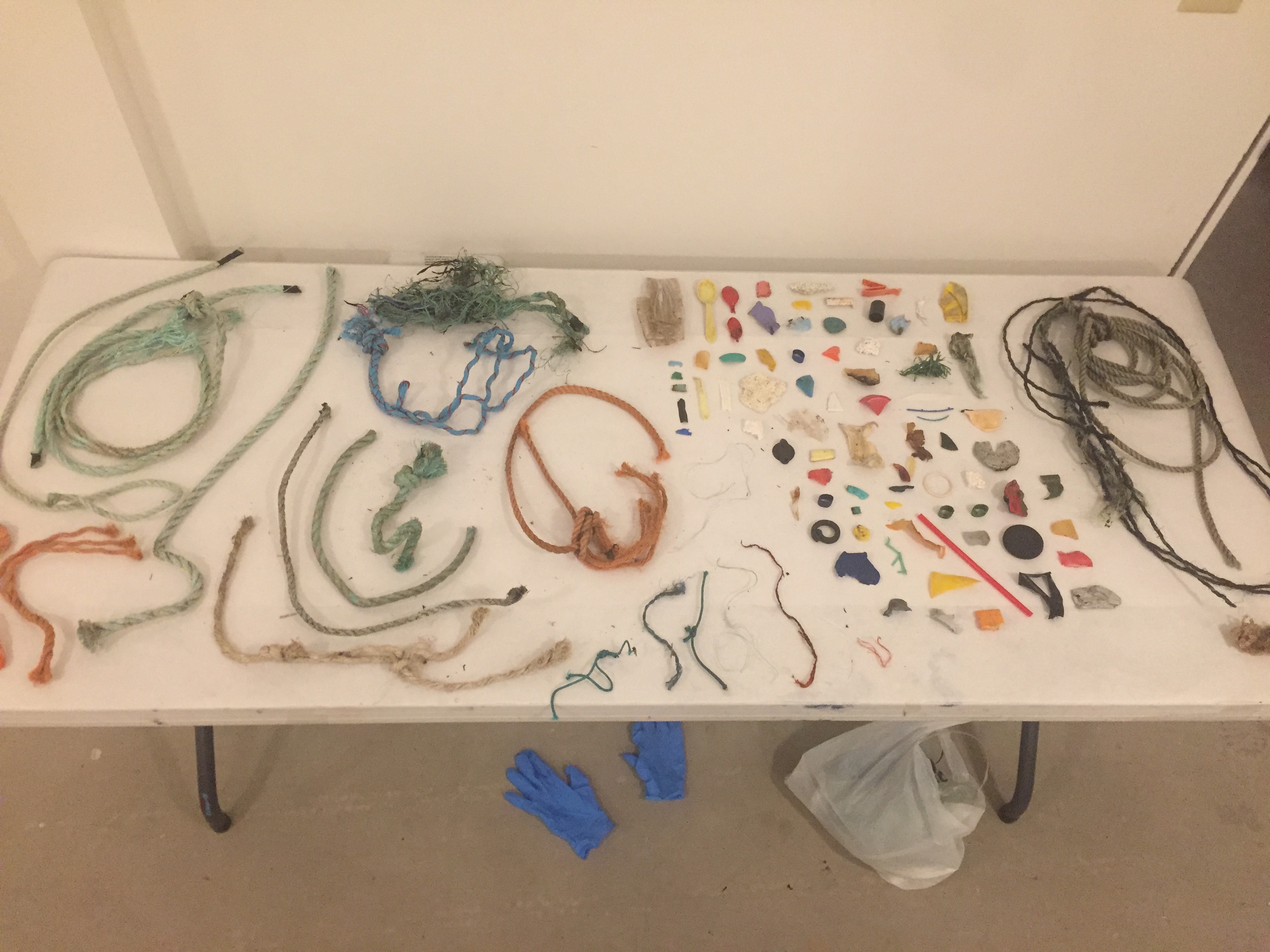
It is these experiences and this collaborative writing that has partly inspired me to begin this project to document the Great Pacific Garbage Patch from afar. Working at the Tides Institute, specifically the waterfront of Eastport, was greatly inspiring to this new body of work. Being near the ocean feels like being near all of the oceans. The way that water is connected throughout our planet makes me feel the connection of this project to the water off the coast of Eastport and back to the waterline in Newark, NJ. Pieces of plastic trash were collected on walks along the coastline in Shackford Head State Park, specifically looking for marine trash to use as source material for my Eastport images. I will walk the Newark waterline to look for similar bits of plastic trash – from these bits I will cobble together a fiction of the garbage patch.

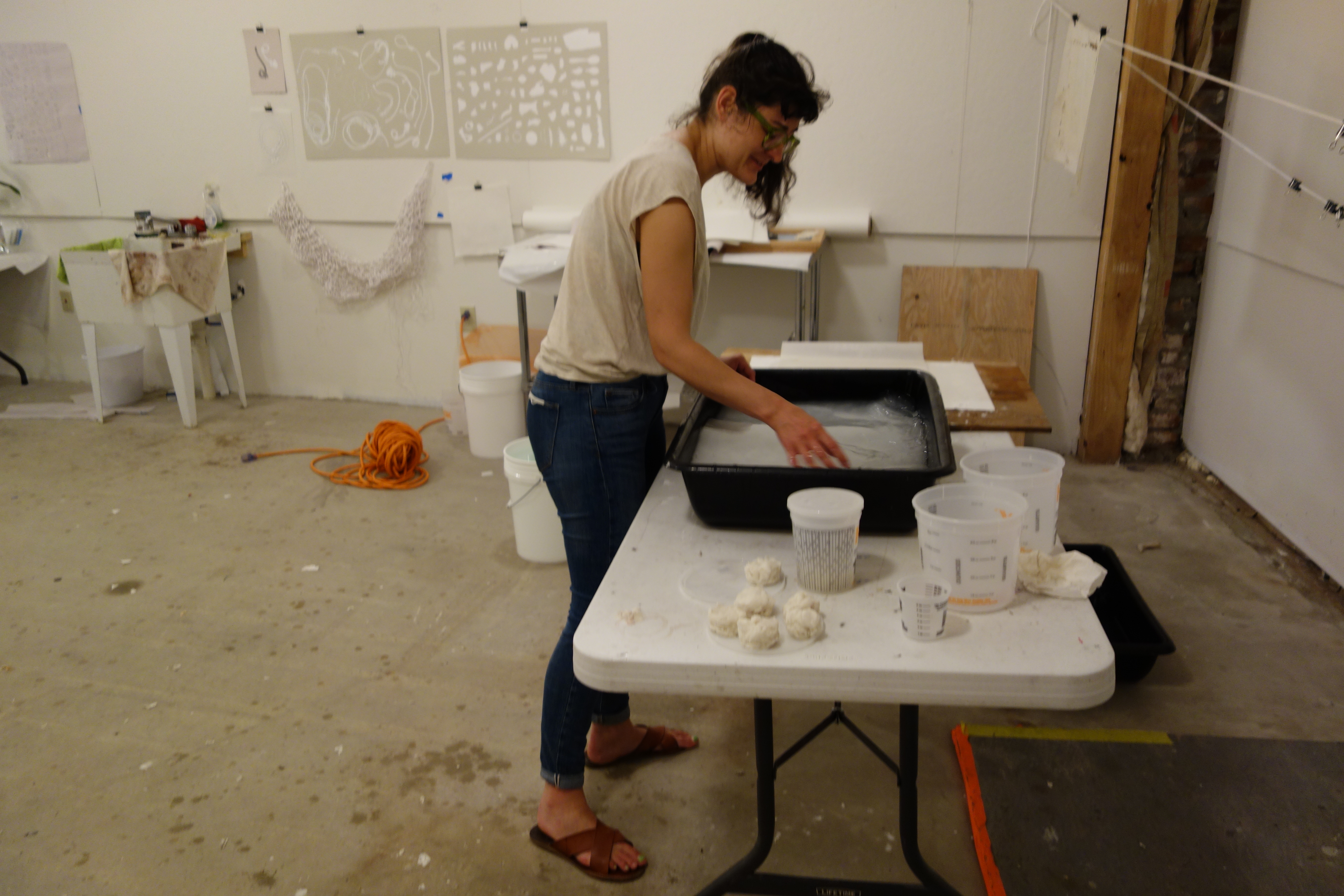
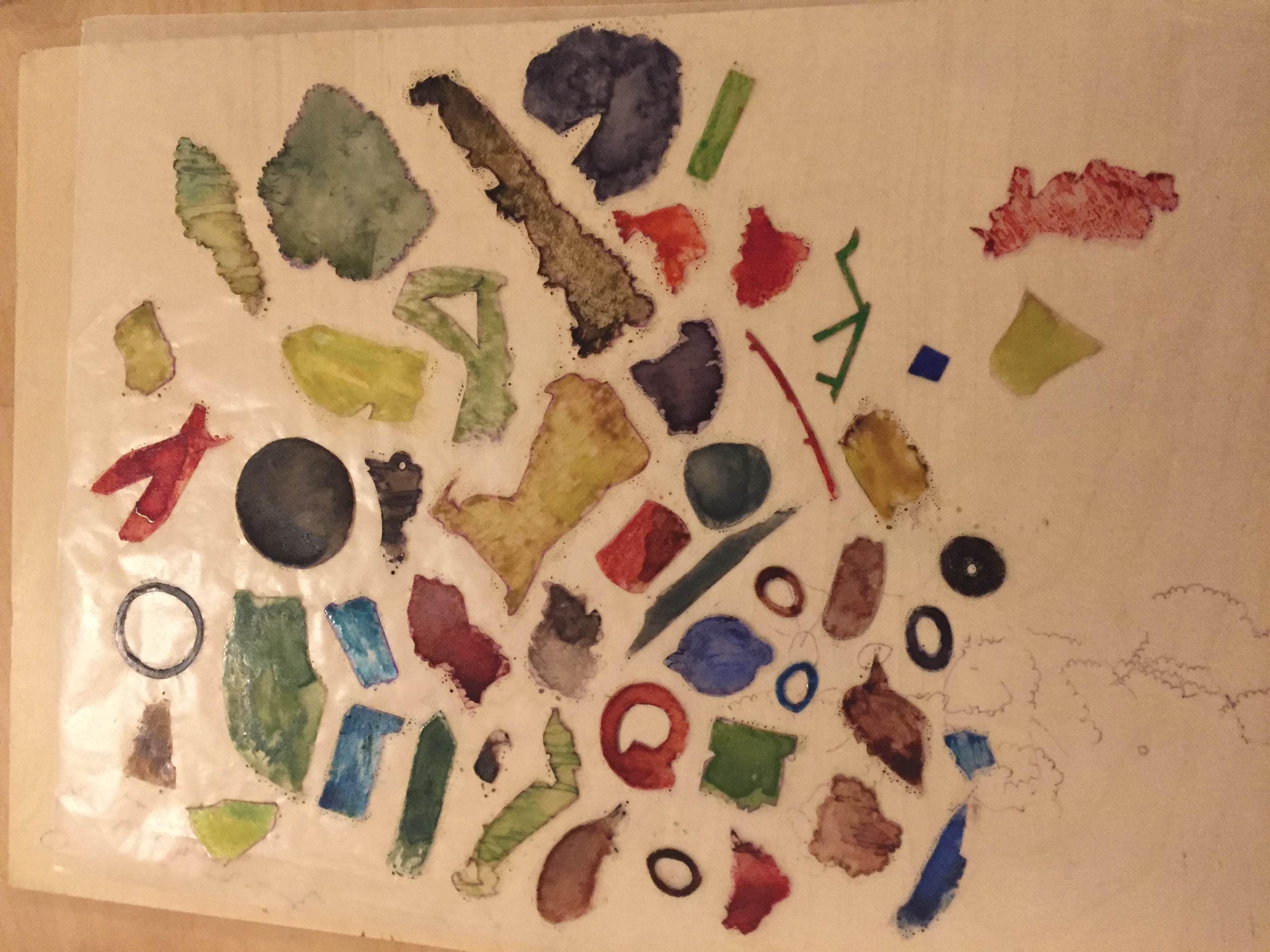
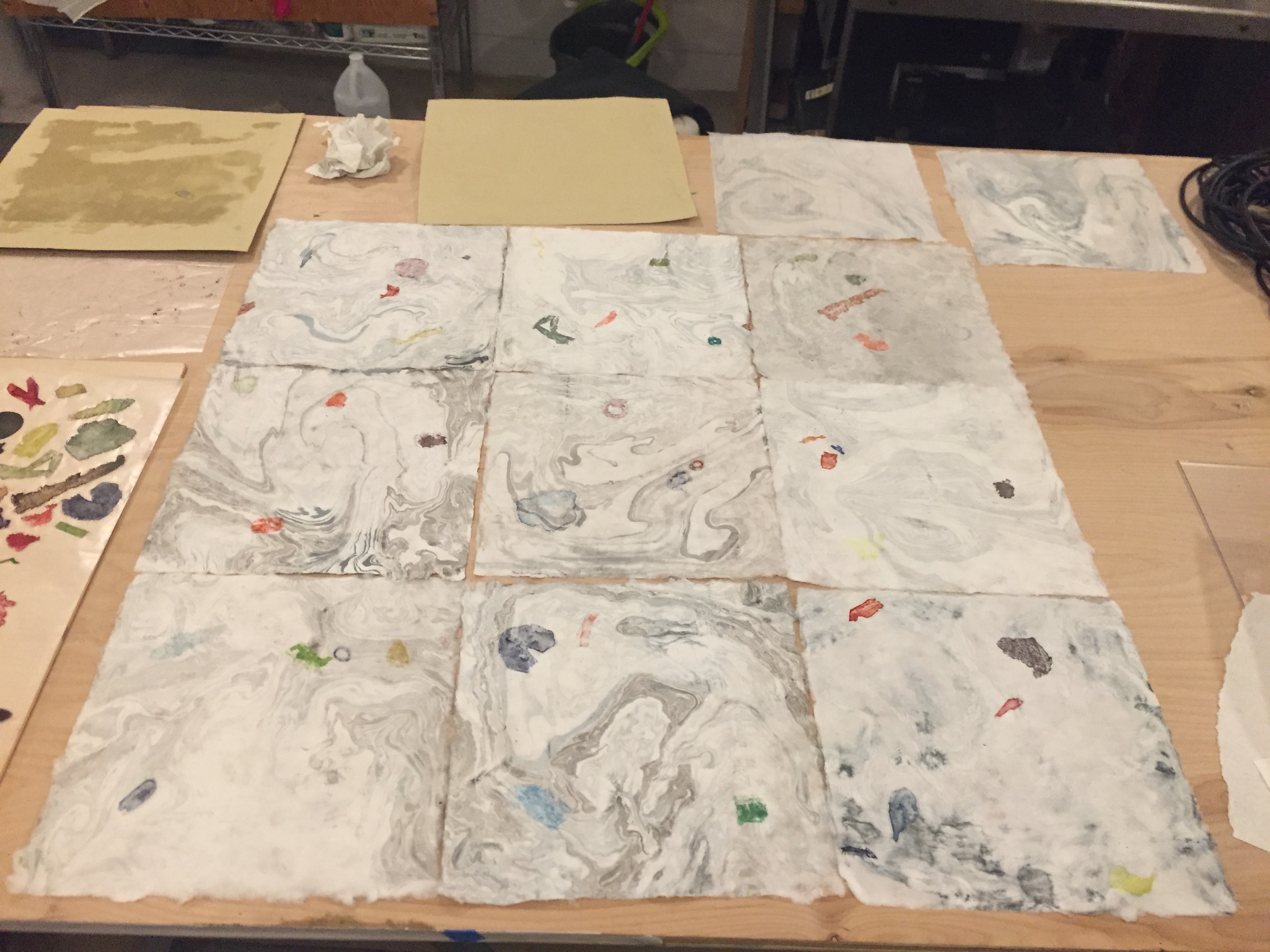
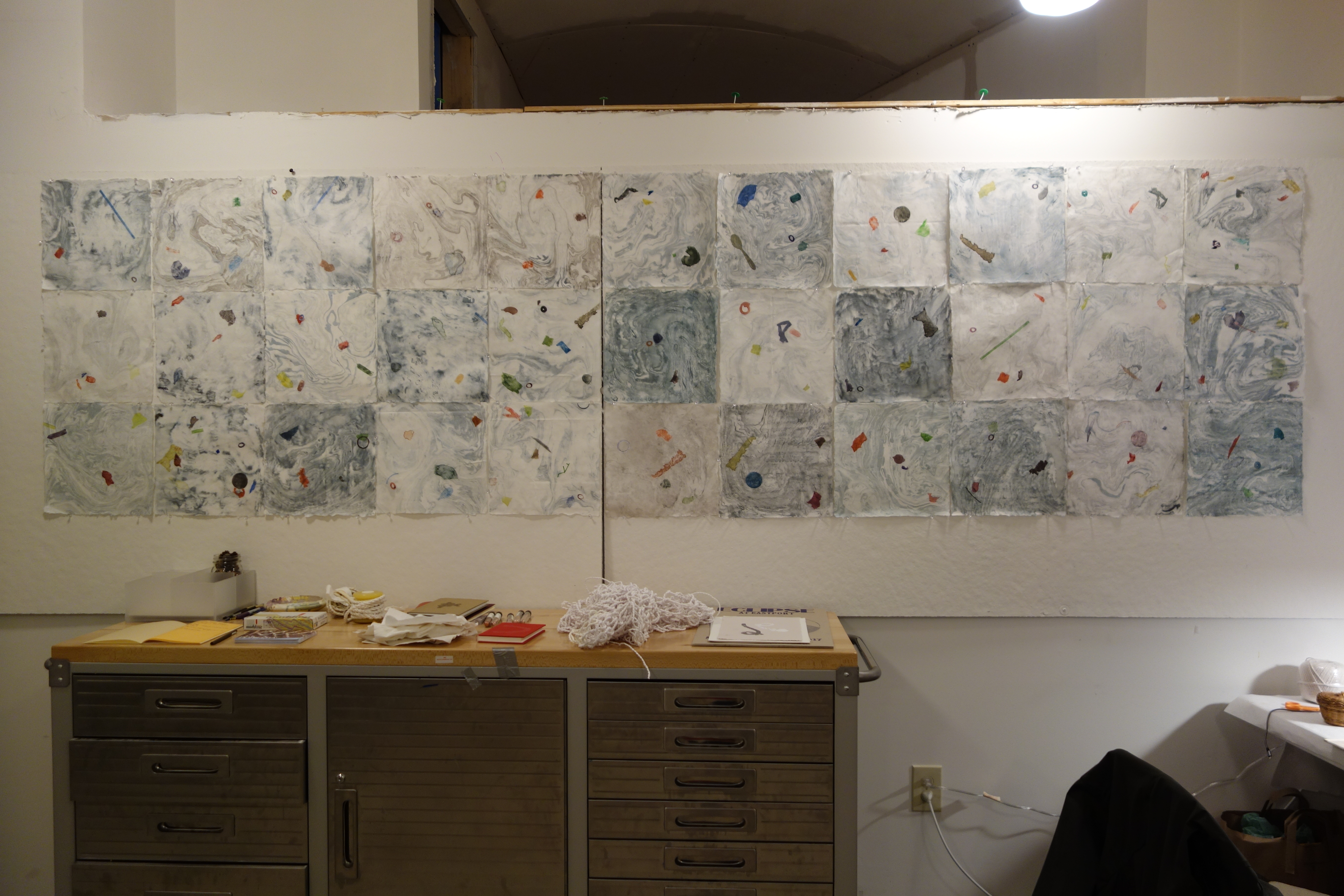
Creating handmade paper from local waters, and using suminagashi and watercolor monoprint, I am creating images of a repetition of shapes throughout the series of work, symbolizing the role of consumerist goods and mass-market culture in the garbage patch. 100 images were made in Eastport, Maine. During the WW11 residency, I will make another 100 images, based on the waterfront of the Passaic River and Newark Bay. Each one of the images will be a modest 1 foot by 1 foot in dimension. These will eventually be followed by 8 other site-specific collections of 100 prints, totaling 1,000 prints at 1,000 square feet, the equivalent of 0.00701459% of the actual garbage patch. But for now, at the end of the WW11 residency, I intend to hang 200 pieces to create a immersive corner installation.

IMG_4991  DSC03249  IMG_5598IMG_5594  DSC03336

Posted in general | Comments Off on Project: 1,000 Square Feet (0.00701459%)

What’s in Our Soil? (working title) by Tamara Gubernat

As a lifelong resident of Greenpoint, Brooklyn I have a conflicted relationship with soil. Greenpoint has some of the highest levels of lead in New York City and testing the soil literally “in my backyard” revealed the shocking results of lead and other heavy metal content much higher than what the Environmental Protection Agency (EPA) deems to be safe. As someone who is passionate about gardening, I have since been on the long road of coming to terms with these results and determining how and in what way I will relate with the soil moving forward. I continue to research the risks and recommended precautions, as well as proposed methods of remediation.

My interest in gardening also extends to “houseplants” – determining what conditions they require to thrive and learning how to propagate them. In many ways, my relationship with plants and soil has helped me through increasingly challenging and uncertain times. Some studies have even indicated that microbes in soil may have naturally occuring antidepressant effects similar to Prozac.

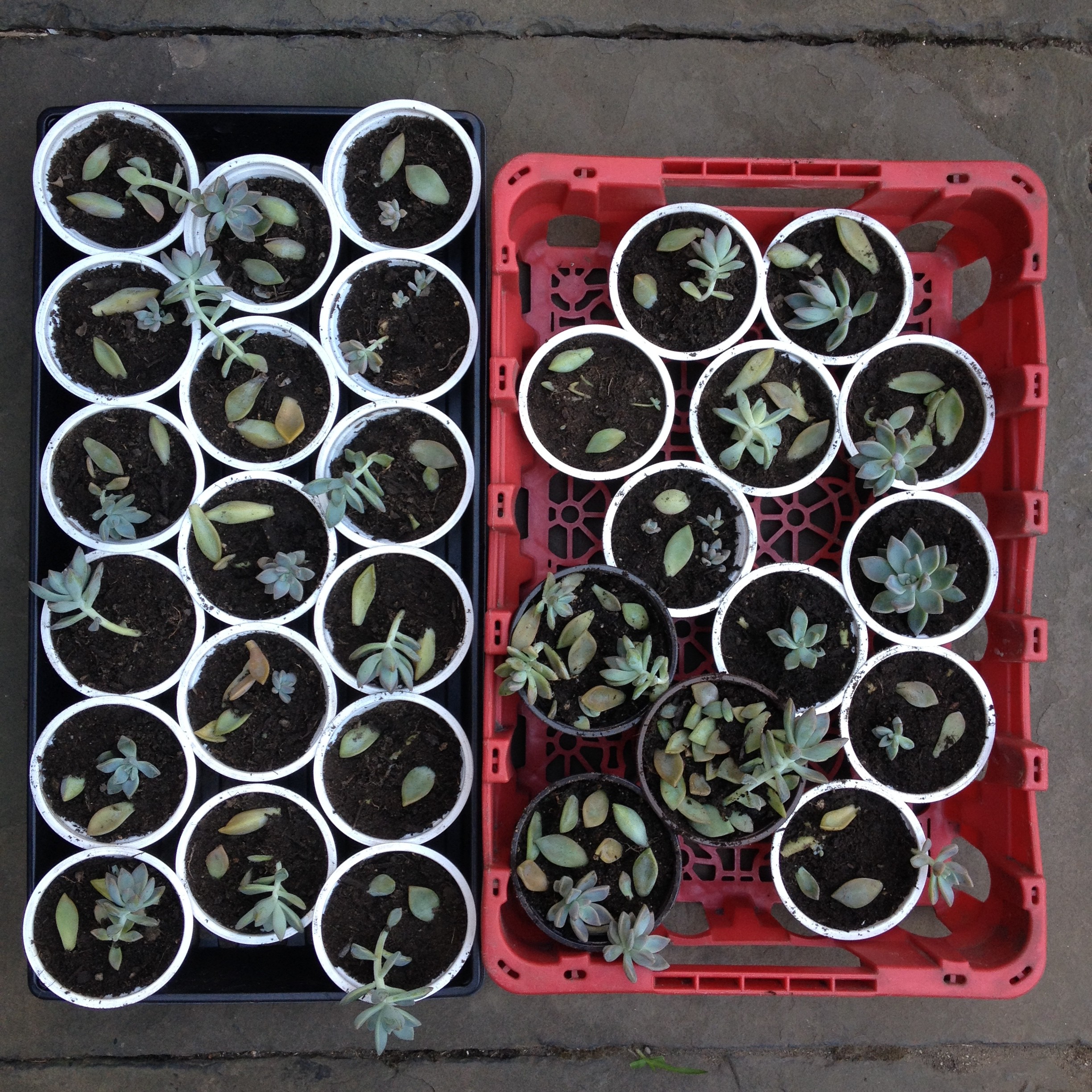
My proposed WW11 project involves propagating some of my existing plants and sharing them with the public for free – creating a situation that provides the opportunity for and facilitates dialogue about issues of contamination. A twist on this gift economy is that the plants will be growing in soil in that consists of a combination of “contaminated” soil from my backyard, compost, and store bought soil. I will create identifying labels/signage to explain that this soil may contain contaminants such as lead and arsenic. Through this project, the public will confront with their own relationship with soil and potential contaminants as well as provide specific information to educate them about the reality of soil contamination as well as precautions and tips on safe handling. Some of the considerations I would like to work through within the residency are potential ways to register public feedback and document these interactions and dialogues that result from this project.

Some larger questions this project will consider include: What are the socio-economic and cultural conditions that result in some areas being more heavily contaminated than others? How can local communities come to terms with contamination? What role does gentrification play in the process of remediation and access to funds to clean up these toxins? How does our personal relationship to the natural environment affect our global connection to natural world?

Ultimately, feeling alienated from the Earth (soil, water, air) makes it easier to continue to defile it. Rebuilding this relationship between humans and soil as the foundation for life, encourages people to be good stewards of the nature and to realize that destroying the earth is actually  destroying ourselves.


Experiments in Propagating Plants 2016

Experiments in Propagating Plants 2016


Posted in general | Comments Off on What’s in Our Soil? (working title) by Tamara Gubernat