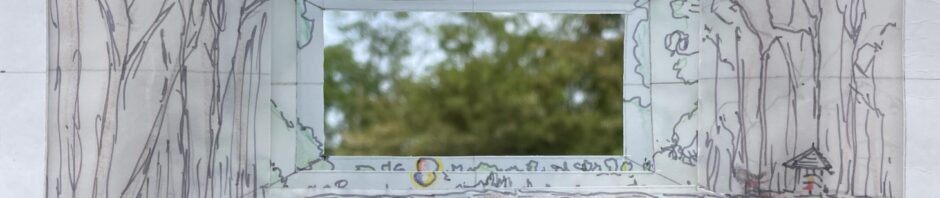
The terrariums continue to grow, still outside a few feet away from where they were dug.
I’m still on the fence about the best format to tell this story, a series of printed out images with text or screen based images with audio/narration. I’ve been working on the text. It feels good to put it down in one place, though I do worry it may be boring for anyone else. Perhaps this is a part of the process that will help me extract the most important elements to use in the piece.
In My Backyard
The magnolia has been in my backyard since before I can remember. We grew up together over the years. It was an early bloomer, showing some the earliest signs of spring each year with it’s fuzzy little buds. It’s twisted branches were brittle and seemed to form little hand forms.
The magnolia started to die off slowly. Some branches broke off in a late spring ice storm as few years back. Maybe the open wound made it susceptible to fungus or disease. First some branches on one side seemed to die off, then two thirds of the tree canopy were dry.
We called an arborist to do a house call and give a diagnosis to see if the magnolia could be saved. It was unlikely that the tree would make it after cutting back the parts that were already dying off. Plus the tree’s advanced age made a successful recovery even less likely. It was a difficult decision, made over a number of family meetings, but ultimately we realized the tree needed to be cut down.
I arranged to be there when the crew came to take down the tree. It was really like loosing an old friend. The crew was very skilled and respectful, but it was still a violent process and a very sad day. I asked to keep a couple of slices of the trunk; one for my brother and one for me.
Ever an optimist, I tried to look at the bright side of loosing the tree. I had always wanted to plant garden but was limited by the shade of the giant magnolia, which created an embracing umbrella of privacy but also excessive dampness and a haven for mosquitos. Our neighbor from the church behind the house confessed that she never liked the tree and was happy it was gone – she said it gave her allergies in the spring.
Without the magnolia, I needed to reacquaint myself with the backyard. Even with the tree cut and the stump ground down x feet, I could still feel its aura occupying the giant canopy. That Thanksgiving we gathered all of the extended family in the U.S. and took a family photo in the place where the tree once stood. Anticipating the intense feeling of loss without the magnolia the following spring I planted 150 tulips. Digging holes for the bulbs I came across a number of smaller bulbs clustered around a larger one in soil that had otherwise been undisturbed for years. I wasn’t quite sure what they were so I left them alone. I also came across lily of the valley leaves, and as some of them became loose I had the opportunity to observe how they grow underground, sending shoots below the soil to launch the next generation.
A gardening friend suggested I test the soil before starting on the other gardening experiments I had in mind for the spring. I collected some samples in plastic bags and sent them to the Brooklyn College Soil lab. Getting the test results back, I was completely shocked! The level of lead was _____, twice? the levels the EPA deem to be safe. There were also high levels of arsenic and _____. Right around this time there were a number of environmental initiatives in Greenpoint, the result of winning the lawsuit against Exxon for a giant underground oil spill that has been slowly leaking into the aquifer under the community for decades. There were opportunities for free soil test, so I could check the soil from a small patch of ivy in front of the house. These results were even worse: (Though this was a ____ method of testing which is considered to be less accurate than the full heavy metal tests done in the lab.) As I planned for the backyard vegetable garden I had always dreamed of, I was suddenly confronted by the fact that the soil is toxic.
In the spring, the tulips bloomed beautifully along with some daffodils that were already there as well as the Star of Bethlehem (the clustering bulbs that I couldn’t identify in the fall. It turns out they are an invasive species that are often spread through other bulbs like tulips or daffodils).
So what to do now? It was already late May, time to get things in the ground especially with the short growing season in the North East. My boyfriend scored a bunch of wood that was being thrown away from work and built three large planter boxes to place above the existing soil in the yard. It would take a lot of dirt to fill these boxes before I could even start to grow anything, and what’s to say that any other dirt I bring not the boxes isn’t toxic as well?
Luckily, I met a woman (Liz) at one of the environmental workshops, who had done a course in permaculture and told me about lasagna gardening. She emailed me with a whole list of local places to source materials, including horse poop, dirt, compost,etc.. and quite an exact recipe and instructions for the combination of ingredients to start to build up clean, healthy soil in my boxes. My mom was generous enough to lend me her car and allow me to transport house poop in it. So armed with a box of garbage bags, gloves and a shovel, I set out to the horse stables near Prospect Park. Sure enough, the very matter of fact staff allowed me to take as much horse poop as I could carry. It turns out the horse poop is mostly straw, since this is what they eat and then it’s mixed with more straw, and really doesn’t smell all that bad.
I covered the wire bottom of my elevated boxes with a cotton fabric that I had on hand to help keep the materials contained, laid down the cardboard and then started layering the horse poop and was on my way to filling the boxes and creating healthy soil. Then there was the ____ from Home Depot – what’s to say that this purchased soil is any better than what’s in my backyard to begin with? It’s not tested or certified or regulated in any way. The finally there was the trip to Build It Green for some buckets of work castings – or black gold as it’s also known. After mixing together the right proportions of potting soil and compost it took quite a while but I was finally ready to plant.
I planted two types of tomatoes, cucumber, pepper, butternut squash, and a number of herbs: thyme, oregano, and basil. I really had no idea how to plant and grow things so each step involved quite some time researching online, learning about companion planting, the importance of thinning seedlings, etc… Throughout this learning curve there was still the question of what to do about the toxic soil in the rest of the backyard…I researched about hyper-accumulators that concentrate and absorb the existing lead in the soil and planted a number of sunflowers along with y brother and his friend for this purpose. The sunflowers grew
to be taller than all of us. I felt like Jack and the beanstalk checking of them as they continued to grow. Further research revealed that in order to use sunflowers as hyper-accumulators, every last part of the sunflower, stack and roots needs to be removed from the ground and technically should be disposed of as toxic waste. In fact, letting these sunflowers dry and discompose in place can actually be even more dangerous in that it pulls up lead that may be sitting dormant below closer to the surface where it is more accessible and dangerous.
So what exactly are the dangers of lead? Is it dangerous to touch, breath, eat?
Here’s a first shot at recording the text as audio narration:
This will be a week of many decisions: the final presentation format, the scope of the story, and the final selection of images. Lots to do!
