Deborah Sperry The Ark –What do you want to save?
When I reflect on “Eye of the Storm” I see a large hole of relative calm. The storm swirls around the periphery dense, menacing and impenetrable. The eye is a pivot around which the storm gathers and destroys. When I was a child my family lived in South Asia. Every year there were hurricanes (typhoons) of various intensities that visited with little warning until they were almost on top of the land unlike today’s satellite imaging and warnings. During one category five storm with winds of 150 MPH the eye passed over the island. What had been artificially dark and insanely loud became calm and light. We peeked out of the door to see what was left. Every living thing had been stripped bare, broken and blown away, nothing seemed to be left.
To that point, we are at this moment in history at which most people would agree that climate change is happening, that it is mostly man made from industrialization and fossil fuel burning and something should be done. What we cannot seem to agree upon is who should do what and how much or when. The Paris Accord moved the needle in a positive direction but held only that nation states should do what they can. The Intergovernmental Panel on Climate Change has been studying and documenting the science of this change for over 3 decades. The IPCC has just published the 7th Assessment of the science gathered worldwide by over 200 climate scientists and agencies. Let me interject here that there are deniers who do not believe the science or who simply believe that everything is just as it should be …I do not wish to engage in that conversation as it is a waste of time. The assessments are tough reading a decoder is needed to get through the language.
Climate change has been described as a problem with a huge “procrastination penalty” With each passing year of inaction, stabilizing the Earth’s climate becomes increasingly difficult. It is according to (Gardener 2011) the perfect moral storm with a generational deferment of consequences. If we choose not to act on this problem now, then the very best case scenario we must accept that our children and grandchildren will grow up in a world lacking some of the beauty and wonder of our world. They may come of age in a time where:
- Polar bears, pikas and numerous other creatures will be the stuff of myth
- There will be no Great Barrier Reef to explore
- Giraffes and elephants will no longer loom in the foreground of the majestic snows of Kilimanjaro
- Great coastal communities such as Amsterdam, Venice, Miami and New Orleans will disappear beneath the waves.
Of course, humankind might plausibly adapt to these sad changes.
In the worst case scenario, however, our grandchildren will grow up, as renowned climate scientist James Hansen has bluntly put it, on “a different planet” – a planet potentially resembling the dystopian world depicted in science fiction movies such as Soylent Green and The Island. Adaptation, in this case is unlikely to be viable for many of the world’s people and other living things. (Michael E 2016)
Which brings me to The Ark Project. What do you want to save? There must be things we can all agree on that have value. In this post-truth world there must be similarities of value that each person must have. If not the world itself, can it be kindness? Or should we try to save each other? I’m not sure of an answer and would very much like to know what other people think about this.
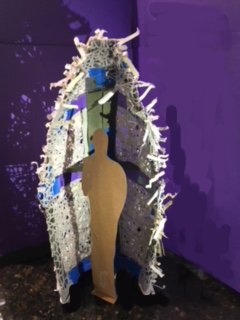
The Ark will be built of cast and shredded paper of the 1st-7th Assessments of the IPCC. It seems a perfect way to disassemble the scientific tome and use it for purposes of understanding. The Ark will act as a facilitator to awareness; a reminder to think on what is most important to each person. As an interactive social agenda the viewer will enter the Ark and write on a piece of paper what they would like to save and then insert the folded or rolled message into a wall of grid-like openings. There will be an additional ongoing step during and following the exhibition that will be facilitated by activating a QR code that will direct a smart phone to a page on my website where future participants can fill in what is valuable to them. I will do a performative reading of the messages that will then be posted to social media websites. This action is something I can continue to do into the future.
In my research, I have found that the traditional methods of boat building will work very well for my project. It is additionally important that the ARK be light weight enough to be moved without heavy equipment or massive disassembly. Fabrics constructed of polymers and paper will complete the skin of the boat.
Works Cited
Gardener, Stephen M. A Perfect Moral Storm: The Ethical Tragedy of Climate Change. New York: Oxford University Press, 2011.
Michael E, Mann and Lee R. Kump. Dire Predictions. New York: Penguin Random House, 2016.


2 Responses to Deborah Sperry 2/6/18