In our collaborative project, we will interrogate collective consciousness by looking inward at our
own family archives. While visiting her grandmother in Ethiopia this summer, Salome found a crumpled
plastic bag of photographs in a shed. Taken by her late grandfather, the images tell the story of not just
one family, but of an entire culture from the 1950s-70s. Amidst Sonia’s late grandmother’s treasured
jewelry and handbags were several folders full of photographs from New Jersey and Virginia, dating as
far back as the 1930s, some with handwritten notes on the backs. As two keepers of our family’s albums,
we plan to use and recreate these precious photographs to combat the fact that women of color very rarely write their own images.
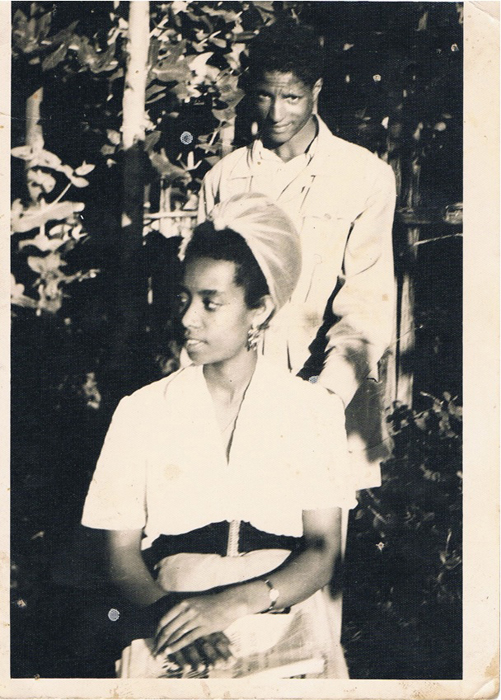
These images hold a sense of the everyday coupled with mass pride. These are images that
history tells us do not exist. Dressed and dapper, professional and upwardly mobile, the black people in
these two parts of the world appear as they are and show us who we are. The images work against what
we are accustomed to seeing in National Geographic or US history textbooks. The lack of a visual record
like this inspires our practice. And although the pictures in our family archives aren’t self-portraits, they
are images of us.

Our family albums are the raw material for our project, we will use these archival photographs
to create new self-portraits. We will create an ongoing archive of images by re-staging and repositioning
scenes from our family albums. Collapsing time and space, 1960s Addis and 1930s Paterson, NJ, come
back to tell us something new. We look into the faces of these women ancestors and see ourselves
reflected and re-framed. We plan to use 4×5 film, both color and black and white, digital photo, video,
and textile in our process. Our multimedia approach speaks directly to the multivocal histories we
are archiving. The empowering nature of making images of each other and ourselves will provide the
foundation for future social practice.
